Eating for ADHD: What to Eat to Support Focus, Energy & Mood
May 8 2026
If you’ve been searching for an “ADHD diet”, you’ve probably come across everything from cutting out sugar entirely to strict elimination protocols promising to transform focus overnight. It’s confusing, often contradictory, and mostly unnecessary.
Here’s the honest version: there is no single diet that cures ADHD. But the way you eat can meaningfully influence focus, energy, mood, and how well your brain manages the demands of the day.
I’m Jessica, a functional medicine nutritionist, and ADHD is one of the areas I’m asked about most often, both from adults trying to manage their own symptoms and from parents wanting to support a child. This article walks through what the research actually says, what tends to work in practice, and where people most often go wrong.
ADHD is a neurodevelopmental condition. It’s not caused by diet, and it can’t be cured by diet. However, nutrition can influence symptom severity and support overall brain health through:
The evidence is fairly consistent. Dietary patterns rich in whole foods, including vegetables, fruit, whole grains, healthy fats, and adequate protein, are associated with better attention and behaviour. Diets high in ultra-processed foods and added sugars are associated with poorer cognitive and behavioural outcomes. And low levels of specific nutrients (particularly iron, zinc, magnesium, and omega-3s) have been linked to more severe ADHD symptoms, with correction of a deficiency sometimes producing meaningful improvements.
Nutrition isn’t the whole picture, but it’s part of the picture.
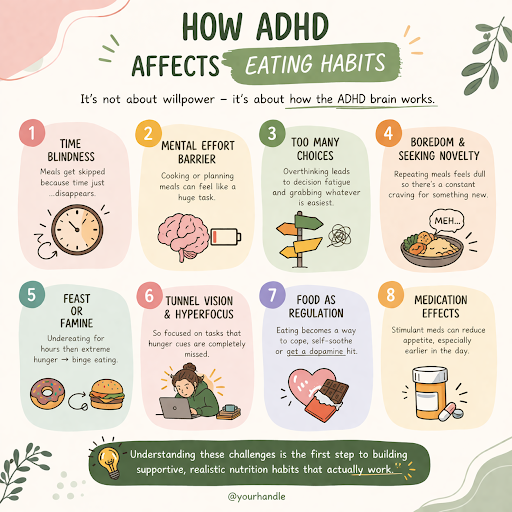
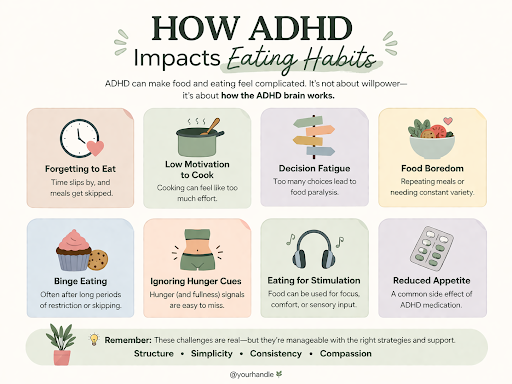
One of the most under-appreciated challenges in ADHD is simply eating regularly. Many of my clients with ADHD find this difficult because of:
Skipping meals then rebounding with sugary or ultra-processed foods creates a cycle of fluctuating energy, reduced concentration, irritability, impulsive food choices, and unstable blood sugar. All of which make ADHD symptoms harder to manage.
What tends to help:
Consistent eating habits are often the single biggest lever for more stable energy, mood, and concentration.
Several nutrients are particularly important for the ADHD brain:
Protein. Provides the amino acid building blocks for neurotransmitters like dopamine and norepinephrine, which underpin attention, motivation, and executive function. Regular protein intake also helps stabilise blood sugar.
Iron and zinc. Both are essential for healthy dopamine production and signalling. Low levels are associated with more severe ADHD symptoms in some children, and correcting a deficiency can meaningfully improve attention and behaviour.
Magnesium. Supports nervous system function and the body’s stress response. Adequate magnesium may promote calmer sleep and reduce restlessness in those who are deficient.
B vitamins, especially B6. B vitamins help convert food into energy and are essential cofactors for making dopamine, serotonin, and GABA. Vitamin B6 plays a particularly important role in neurotransmitter synthesis.
Omega-3 fatty acids. EPA and DHA are structural components of the brain and support communication between brain cells. Meta-analyses show that omega-3 supplementation produces modest but real improvements in ADHD symptoms, particularly in those with a low baseline intake.
Vitamin D. Supports brain development, immune function, and neurotransmitter activity. Low vitamin D levels are common and have been linked to poorer cognitive and behavioural outcomes. Supplementation is most useful where a deficiency is confirmed.
Fibre. Feeds the beneficial bacteria in the gut, which produce compounds that support the gut–brain axis. Most people eat only about half the recommended daily fibre (around 15 g, against a recommended 25–30 g), leaving gut bacteria underfed and gut–brain communication less well supported.
Important: these nutrients support brain function; they don’t replace medication, therapy, or behavioural support for ADHD.
Rather than fixating on restrictions, focus first on what to add in:
A Mediterranean-style dietary pattern is consistently associated with better cognitive function and, in some studies, fewer ADHD symptoms. It’s a good default template.
Sugar does not cause ADHD, and current research does not support cutting out sugar as an ADHD treatment. However, high intakes of added sugar can contribute to energy fluctuations, mood swings, difficulty concentrating, and unstable blood sugar, all of which can amplify ADHD symptoms.
You don’t need to be sugar-free. Focus on limiting added sugars, not the naturally occurring sugars in whole fruits, vegetables, or dairy. Whole fruit brings fibre, vitamins, and antioxidants and should stay in the diet.
A subset of children (with and without ADHD) appears to be sensitive to certain artificial food colours, including tartrazine, Allura Red, and Sunset Yellow. Some studies suggest these can increase hyperactivity or inattention in susceptible individuals. Certain preservatives such as sodium benzoate have shown similar effects, though the evidence is less consistent.
The key points:
Elimination diets can be genuinely useful for a subset of people, particularly those with a diagnosed food allergy, a food sensitivity, or co-existing gastrointestinal symptoms. They are not appropriate as a first-line strategy for everyone with ADHD.
Where elimination is clinically indicated, I use a structured 5R framework to protect nutritional adequacy and support long-term gut health:
Foods are then systematically reintroduced to identify true triggers, rather than eliminated indefinitely.
Bottom line: eliminate foods based on clinical evidence, not IgG results or assumptions.
Most people who come to me about ADHD and nutrition start with the same question: “What foods should I cut out?”
But the real issues are almost always further upstream:
Get these foundations in place first. The biggest wins almost always come from eating regular meals, including protein at each one, increasing fibre from whole foods, and building simple routines that survive a busy week, rather than from cutting anything out.
| Meal | Foods |
| Breakfast | Scrambled eggs on wholegrain toast with avocado and berries |
| Lunch | Chicken or tofu with brown rice, roasted vegetables, and olive oil dressing |
| Snack | Greek yoghurt with mixed nuts and a square of dark chocolate |
| Dinner | Salmon with baked potato, greens, and a spoonful of pesto |
This kind of pattern delivers protein at each meal, plenty of fibre, omega-3s, iron, zinc, magnesium, and stable blood sugar throughout the day without requiring anything to be eliminated.
Does sugar make ADHD worse?
Sugar doesn’t cause ADHD, but large amounts of added sugar can worsen the energy, mood, and concentration fluctuations that make ADHD symptoms harder to manage. Focus on limiting added sugars rather than eliminating all sugar.
Should my child take an omega-3 supplement?
Possibly. The evidence suggests modest but real benefits, particularly for those with a low omega-3 intake. A supplement providing around 500–1,000 mg combined EPA and DHA per day is a reasonable starting point, but it’s worth checking in with a nutritionist or GP first.
Can nutrition replace ADHD medication?
No. Nutrition supports the brain and can meaningfully improve symptoms, but it isn’t a substitute for medication, therapy, or behavioural strategies where these are appropriate. Think of it as one important pillar within a broader treatment plan.
What about caffeine?
Caffeine can improve focus for some people with ADHD but worsen anxiety, sleep, and appetite in others (especially alongside stimulant medication). If you use it, keep it earlier in the day and pair it with food.
Are there any supplements worth considering?
The most useful supplements are those correcting a confirmed deficiency (commonly iron, zinc, vitamin D, or magnesium) plus omega-3s, where dietary intake is low. Everything else is best guided by an individualised assessment.
Consider working with a nutritionist or dietitian if you (or your child):
The most effective approach to ADHD is usually integrative, combining medical care, behavioural or psychological support, and nutrition, rather than any single element on its own.
There is no single “ADHD diet,” and anyone selling you one is oversimplifying. What actually helps is far less glamorous: regular meals, enough protein and fibre, adequate key nutrients, stable blood sugar, and a food pattern you can sustain in real life.
Build the foundations first. The rest can follow.
If you’d like help putting that plan together, I’d love to chat.
Ready to feel more focused, steady, and in control of your day? Book a complimentary 10-minute discovery call to talk through your goals.
Jessica Woodruff is the founder of MindNourish Nutrition, a Singapore-based functional nutrition practice that works alongside doctors and psychologists to support women’s mental and physical well-being through evidence-based nutrition.
Disclaimer: This article is for educational purposes only and is not a substitute for medical advice, mental health care, or ADHD-specific treatment. Nutrition can support the management of ADHD symptoms but should not replace medication, therapy, or behavioural support where these are recommended by your healthcare team. Please consult a qualified professional before starting any supplement, elimination diet, or significant dietary change, particularly for children.
References: Del-Ponte, B., et al. (2019), Dietary patterns and attention deficit/hyperactivity disorder (ADHD): a systematic review and meta-analysis, Journal of Affective Disorders 252:160–173; Bloch, M. H., & Qawasmi, A. (2011), Omega-3 fatty acid supplementation for the treatment of children with ADHD symptomatology: systematic review and meta-analysis, JAACAP 50(10):991–1000; Nigg, J. T., et al. (2012), Meta-analysis of attention-deficit/hyperactivity disorder or ADHD symptoms, restriction diet, and synthetic food color additives, JAACAP 51(1):86–97; Wang, Y., et al. (2017), Iron status in ADHD: a systematic review and meta-analysis, European Child & Adolescent Psychiatry 26:1053–1067; Cortese, S., et al. (2016), Association between ADHD and obesity: a systematic review and meta-analysis, American Journal of Psychiatry 173:34–43; Rucklidge, J. J., et al. (2018), Vitamin-mineral treatment of ADHD in adults: a 1-year naturalistic follow-up of a randomised controlled trial, Journal of Attention Disorders 22(5):424–434.
Bloating after every meal. Excessive gas.... Read more

Walk into any supermarket, and you'll fi.... Read more

Most of us know calcium is important for.... Read more
Feeling constantly tired and low on ener.... Read more

When most people think about mental heal.... Read more